Install & first runs
Install just this family — one plugin, 8 skills. General-issue lifecycle: triage, reproduction, dedup, backlog.
Once you have added the marketplace:
/plugin install magpie-issue@apache-magpieNew to Magpie? The quick start walks the whole path in
one place — install, the first /magpie-setup:setup run, and a recording of it
happening — plus the other agents and the secure-isolation setup to run next.
The first issue skill you run opens with a one-minute
welcome guide:
the typical flow, what needs configuring, what to ask it, and how to make it yours.
Dismiss it, or hide it for good, from its last line;
“show the issue welcome again” or /magpie-setup:welcome-guide issue brings it back.
Before the first run
Illustrative — the real run derives more and asks better. What is true is the shape: it runs itself, it writes only your personal layer, and it stages nothing.
Every skill here resolves project-specific values from the adopter’s
<project-config>/ directory — which is
your personal layer first — .apache-magpie-local/ (gitignored) in a
project that adopted Magpie, <git-common-dir>/apache-magpie/ in one
that did not — then .apache-magpie-overrides/ (committed, the project’s).
For yourself: /magpie-setup:setup config scaffolds and fills these locally
(/magpie-setup config on a pinned-snapshot install).
Nothing is staged, nothing is committed, and it works on a repository that
has never adopted Magpie.
For the project: /magpie-setup:setup adopt
commits them for every contributor, either scaffolded directly or promoted
from what you configured locally.
Required. Without these a skill would act on a guess, so it stops and says which file is missing.
| File | What it carries | Read by |
|---|---|---|
fix-workflow.md |
Fork / clone / toolchain specifics, backport-label policy, commit-trailer wording, PR scrubbing, private-PR fallback. | fix-workflow |
issue-tracker-config.md |
Tracker URL, project key, auth model, default query templates. | backlog-stats, deduplicate, reassess, reassess-stats, reproducer, stale-sweep, triage |
project.md |
Project manifest. Identity, repositories, mailing lists, tools enabled, CVE tooling, GitHub project-board + issue-template field declarations. The single file every skill reads to resolve project-scoped references. | stale-sweep, triage |
reassess-pool-defaults.md |
Named pools for reassessment sweeps (open-eol, reopened, stale-unresolved, project-specific). |
reassess |
reproducer-conventions.md |
Evidence-package directory layout and frozen-copy discipline. | reproducer |
runtime-invocation.md |
Build prerequisite, run-a-single-file recipe, stream-capture conventions, network/dependency handling. | fix-workflow, reproducer |
Optional. Each has a documented fallback; absent, the skill still runs.
| File | What it carries | Read by |
|---|---|---|
canned-responses.md |
Reusable reporter-facing reply templates. | triage |
release-trains.md |
Active release branches, release-manager attribution per cut, rotation rosters, security-team roster. | triage |
scope-labels.md |
Scope label → CVE product / packageName / collection-URL mapping. Exactly one scope label per tracker. |
backlog-stats, reassess, triage |
stale-sweep-config.md |
Grace windows and exemption labels for stale sweeps. Absent, the framework defaults apply. | backlog-stats, stale-sweep |
Try these first
Illustrative shapes, not real transcripts — your output will differ. Nothing below sends, merges, or posts anything without you confirming it.
Triage the new issues.
/magpie-issue:triage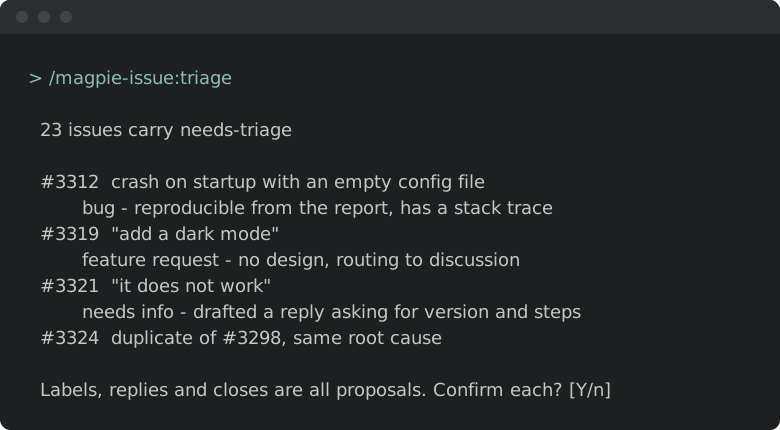
Find the duplicates.
/magpie-issue:deduplicate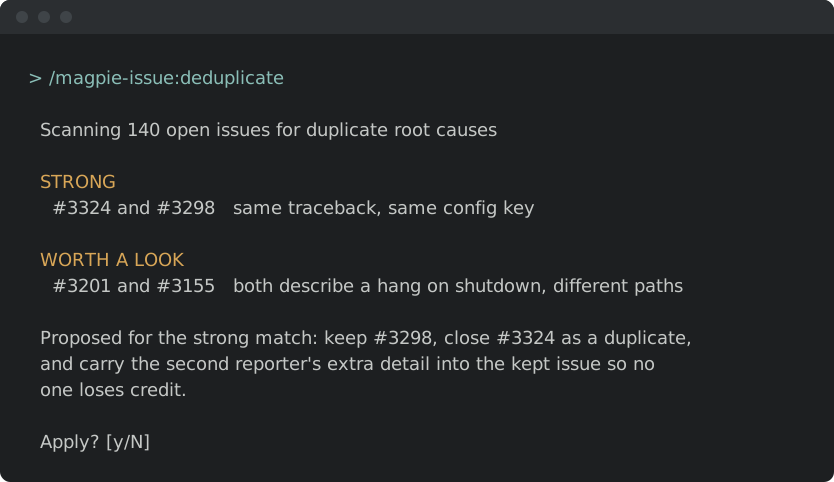
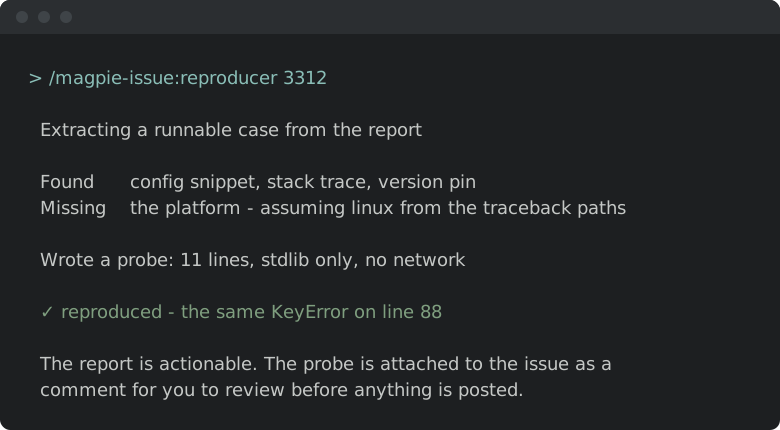
Try to reproduce one.
/magpie-issue:reproducer