
Release-management skill family
Scope —
organization: ASF· 🪶 ASF-specific. This family encodes Apache Software Foundation processes (the 14-step release lifecycle) and assumes an ASF adopter profile by default. Non-ASF projects can still adopt it through the adapter/config layer, but it carries ASF assumptions the generic families do not.
End-to-end automation for an ASF project’s release lifecycle,
from the planning issue and version bump through to [ANNOUNCE]
on announce@apache.org, archive sweep, and the per-release
audit log. Ten skills that compose into the canonical 14-step
process documented in process.md.
Why a framework skill family? Every ASF project runs essentially
the same release process: version bump, KEYS reconciliation, RC
signed with the Release Manager’s key, staged to
dist/apache.org/repos/dist/dev/<project>/, voted on dev@ per
release-policy.html § release approval,
promoted to dist/release/<project>/, announced on
announce@apache.org per
release-policy.html § announcements,
and archived past retention per
release-distribution.
The procedural shape is foundation-wide; the project-specific
content (release-train identity, build invocation, KEYS file
path, vote-window length, retention rule, audit-log location)
plugs in through <project-config>/
just like the security family.
Non-ASF adopters are first-class adopters of this family, not a
follow-up case. The 14-step lifecycle is described in ASF
terminology because the framework’s first pilot is an ASF PMC,
but every step that touches an ASF-specific surface is implemented
as a backend call the adopter selects in
release-management-config.md.
Three dimensions parametrise the lifecycle, with no ASF assumption
baked into the install path:
- Distribution backend (
release_dist_backend):svnpubsub(ASF),github-releases,s3,self-hosted. - Approval mechanism (
release_approval_mechanism):dev-list-vote(ASF),github-discussion,pr-approval,maintainer-roster. - Announcement backend (
release_announce_backend):announce-list(ASF),github-release-notes,site-post,discord-channel.
The 14 steps stay identical across backends; only the command set
the agent emits changes. The state-change boundaries (Agentic Drafting vs
Agentic Triage; agent never holds the signing key; agent never publishes)
stay identical too. See
process.md § Adopter backends
for the full backend table and per-step mapping.
Install & first runs
Install just this family — one plugin, 10 skills. The 14-step ASF release lifecycle. The agent never holds your signing key.
Once you have added the marketplace:
/plugin install magpie-release-management@apache-magpieNew to Magpie? The quick start walks the whole path in
one place — install, the first /magpie-setup run, and a recording of it
happening — plus the other agents and the secure-isolation setup to run next.
Before the first run
Illustrative — the real run derives more and asks better. What is true is the shape: it runs itself, it writes only gitignored files, and it stages nothing.
Every skill here resolves project-specific values from the adopter’s
<project-config>/ directory — which is
.apache-magpie-local/ (gitignored, yours) first, then
.apache-magpie-overrides/ (committed, the project’s).
For yourself: /magpie-setup config scaffolds and fills these locally.
Nothing is staged, nothing is committed, and it works on a repository that
has never adopted Magpie.
For the project: /magpie-setup adopt
commits them for every contributor, either scaffolded directly or promoted
from what you configured locally.
Required. Without these a skill would act on a guess, so it stops and says which file is missing.
| File | What it carries | Read by |
|---|---|---|
pmc-roster.md |
Who is binding. Read wherever a vote is counted or a PMC-only action is gated. | promote, vote-tally |
release-build.md |
How this project builds and signs artefacts: reproducible source-archive recipe (git archive + .gitattributes), build command, the project’s optional convenience artefacts (each with its own build, staging, reproducibility mode, vote scope and publish channel), artefact names, checksum algorithm, optional reproducibility checks. |
rc-cut, verify-rc |
release-management-config.md |
Vote window and pass rule, distribution backend and paths, announce/vote list addresses, retention rule. | announce-draft, archive-sweep, audit-report, keys-sync, prepare, promote, rc-cut, verify-rc, vote-draft, vote-tally |
release-trains.md |
Active release branches, release-manager attribution per cut, rotation rosters, security-team roster. | archive-sweep, prepare |
Optional. Each has a documented fallback; absent, the skill still runs.
| File | What it carries | Read by |
|---|---|---|
canned-responses.md |
Reusable reporter-facing reply templates. | announce-draft, vote-draft |
Try these first
Illustrative shapes, not real transcripts — your output will differ. Nothing below sends, merges, or posts anything without you confirming it.
Open the release plan.
/magpie-release-management:prepare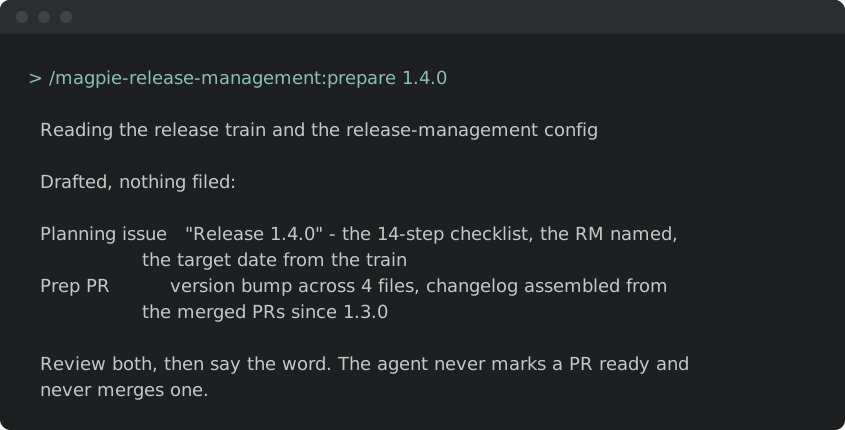
Check an RC before you vote.
/magpie-release-management:verify-rc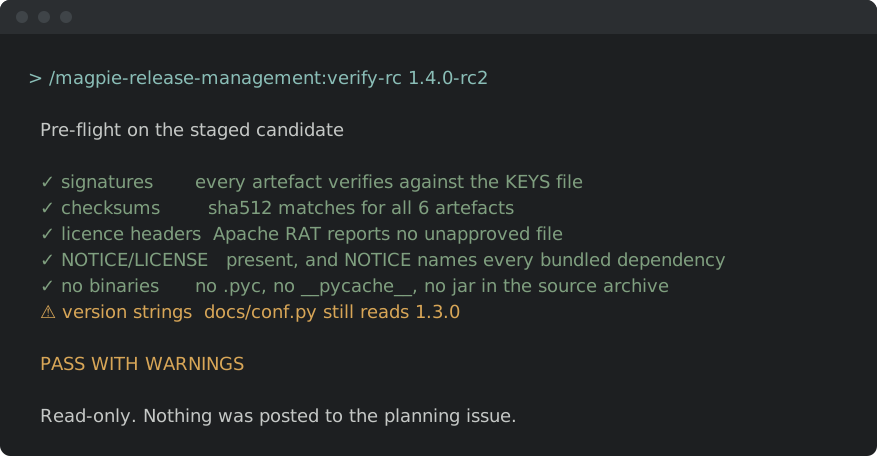
Tally the vote thread.
/magpie-release-management:vote-tally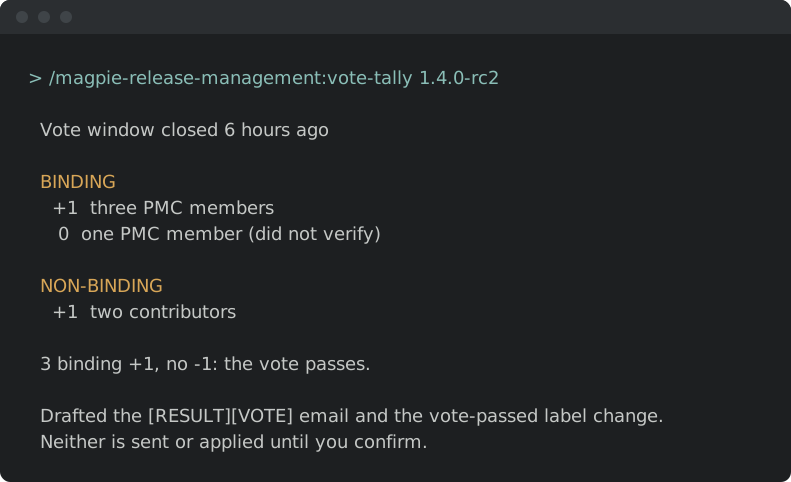
Status
Experimental — all 10 skills shipped. The family is
feature-complete; every skill landed as experimental with an
eval suite:
| Skill | PR | Step(s) |
|---|---|---|
release-prepare |
#540 | 1, 2, 14 |
release-keys-sync |
#541 | 3 |
release-rc-cut |
#543 | 4, 5 |
release-verify-rc |
#537 | 6 |
release-vote-draft |
#582 | 7 |
release-vote-tally |
#533 | 9 |
release-promote |
#544 | 10 |
release-announce-draft |
#512 | 11 |
release-archive-sweep |
#551 | 12 |
release-audit-report |
#552 | 13 |
Every skill is flagged experimental and tracked in
docs/modes.md.
The family landed as docs first (this README, the 14-step
process.md, the per-skill spec.md, and
the adopter scaffold
projects/_template/release-management-config.md)
so the lifecycle, the state-change boundaries, and the adopter
contract are reviewable independently from runtime behaviour.
This pattern matches Mentoring.
Promotion of any skill in this family from experimental to
default-on, or from Agentic Drafting to a state-changing lane, requires
evidence sourced from Release Managers and binding voters that
the project’s release process is healthier (fewer stalled
RCs, shorter time-to-[ANNOUNCE], fewer reverted promotions),
not throughput numbers alone. The evidence window is set by
adopter governance, not by this family.
See MISSION.md § Initial Goals
for the commitment to cut a first Apache release through the
standard process within 3 months of resolution adoption; this
family operationalises it.
Skills
The skill table below names each release-* skill, its mode, and
the lifecycle step(s) it owns. Read spec.md for the
per-skill state-change boundary; read process.md
for the step it executes against.
| Skill | Mode | Steps owned | Status | Purpose |
|---|---|---|---|---|
release-prepare |
Agentic Drafting | 1, 2, 14 | experimental | Open the planning issue, draft the version-bump + changelog + NOTICE/LICENSE PR, then draft the post-release -SNAPSHOT bump. |
release-keys-sync |
Agentic Drafting | 3 | experimental | Draft the KEYS diff for a Release Manager cutting their first release for the project. Agent never holds the private key. |
release-rc-cut |
Agentic Drafting | 4, 5 | experimental | Emit the paste-ready command sequence, signed tag, build, detached signatures, checksums, svn import to dist/dev/<project>/. Agent never signs and never imports. |
release-verify-rc |
Agentic Triage / Agentic Pairing | 6 | experimental | Read-only pre-flight: signatures against the project’s KEYS, checksums, license headers (Apache RAT), NOTICE/LICENSE presence, no prohibited binaries, version-string consistency. Voters can run it in their own dev loop before posting +1. |
release-vote-draft |
Agentic Drafting | 7 | experimental | Draft the [VOTE] email body to dev@<project>. Agent never sends. |
release-vote-tally |
Agentic Triage | 9 | experimental | Parse the vote thread, classify each reply (+1 / 0 / -1) binding vs non-binding against the PMC roster, propose [RESULT] [VOTE]. Conservative on ambiguous votes, refuses to count, flags AMBIGUOUS, needs RM call. |
release-promote |
Agentic Drafting | 10 | experimental | Emit the paste-ready svn mv dist/dev → dist/release command set plus commit message. Agent never moves; the human commit is the act of release. |
release-announce-draft |
Agentic Drafting | 11 | experimental | Draft the [ANNOUNCE] email body to announce@apache.org and the site-bump PR (download page, release notes, version banner). Agent never sends mail and never merges the site PR. |
release-archive-sweep |
Agentic Triage | 12 | experimental | Scan the distribution area, identify releases past retention, propose the backend-shaped archival step — the svn mv sequence under svnpubsub, or archiving in ATR (which removes the files from dist/release itself) under atr. Agent never archives. |
release-audit-report |
Agentic Triage (dashboard) | 13 | experimental | Read-only structured report per release, RM, voters with binding flags, artefacts with sigs and checksums, promotion revision, [ANNOUNCE] archive URL. Output appended to the project’s audit log. |
Two non-negotiable boundaries cross every Agentic Drafting skill above:
- The agent never holds, invokes, or proxies the Release
Manager’s private signing key. Steps 3, 4, 10 emit paste-ready
recipes; the RM runs every signing or
svn commitoperation as themselves. This mirrorssecurity-cve-allocate(Vulnogram URL + paste-ready JSON, human submits) and satisfies RFC-AI-0004 Principle 1. - The agent never publishes the release. Steps 10
(
svn mv dist/dev → dist/release) and 11 ([ANNOUNCE]send, site bump merge) are the moments of release; the agent drafts artefacts, the RM and the PMC execute and merge.
Deep documentation
process.md, the 14-step lifecycle with Mermaid flowchart + per-step description; the label-lifecycle state diagram + label reference table. The authoritative process reference.spec.md, per-skill scope, state-change boundary, hand-off protocol, adopter knobs. The contract the future skill implementations must satisfy.svn-release-runbook.md, the hands-on copy-paste command sequence for thesvnpubsubbackend: package a tagged revision as a signed source.zipwith SHA-512 and stage it todist/dev/(lifecycle Steps 4–5). The longhand companion torelease-rc-cut.atr-release-runbook.md, the counterpart runbook for theatr(Apache Trusted Releases) backend: compose a signed candidate in ATR, let the platform run the policy checks and drive the[VOTE], then finish to publish and announce. Same 14-step lifecycle and same skills as thesvnpubsubrunbook; ATR replaces the mechanics of Steps 5–11. ATR is in beta and is Magpie’s release backend — start here.manual-release-process.md, the concrete as-executed record of the0.1.0release on the now-retired hybrid backend (release_dist_backend = svnpubsub+release_vote_backend = atr): the exact command sequence run, the real URLs, and therc1/rc2rough edges. Kept as history — the hybrid was retired in #1182 — not as the procedure to follow.
Two documents that do not ship in this family but are referenced from it:
<project-config>/release-trains.md, release-train identity (already present in the adopter scaffold for security use; release-management reuses it).<project-config>/release-management-config.md, the family’s adopter contract (new in this PR).
Mode mapping
Release-management is a family, not a mode. The lifecycle
spans the existing Agentic Triage and Agentic Drafting modes; no new mode is
introduced. See docs/modes.md for the
family-by-mode breakdown; release-* skills appear under the
Agentic Triage and Agentic Drafting subsections (all ten skills are now
experimental; the family is feature-complete).
The family’s read-only dashboard skill
(release-audit-report)
sits in Agentic Triage because it classifies and reports against existing
state, not because it routes inbound work. The
docs/modes.md § Meta
section is reserved for framework infrastructure (setup-*,
issue-reassess-stats, isolation tooling) and the audit skill
does not belong there, it is project-facing maintainership work.
Cross-references
process.md,spec.md, within this family.MISSION.md§ Initial Goals, the standard-release commitment this family operationalises.docs/modes.md, the mode taxonomy each skill in this family inhabits.docs/security/README.md, the precedent for a multi-skill ASF-process family with shared state-change-boundary discipline.docs/mentoring/README.md, the precedent for spec-before-code on a proposed family.- ASF release policy, ASF release distribution, ASF release signing, ASF licensing-howto, Apache RAT, the canonical foundation references the lifecycle is anchored to.