
Repo-health audits — family overview
Scope. Works on any project, ASF or not — no Apache-Software-Foundation-specific assumptions baked in.
Read-only agent-assisted audits that surface repository maintenance signals a human would otherwise have to detect by hand: runner label obsolescence, Actions workflow security issues, stale or vulnerable dependencies, license/NOTICE drift, and flaky-test patterns. Every skill in this family produces a human-readable report and proposes remedies; applying any change is the maintainer’s action.
The family lives under mode: Triage in the framework taxonomy — the same
classify-and-propose discipline the security and PR-management triage skills
follow. See docs/modes.md § Triage.
Install & first runs
Install just this family — one plugin, 7 skills. Read-only repository-health audits, plus fixes for what they find.
Once you have added the marketplace:
/plugin install magpie-repo-health@apache-magpieNew to Magpie? The quick start walks the whole path in
one place — install, the first /magpie-setup run, and a recording of it
happening — plus the other agents and the secure-isolation setup to run next.
Before the first run
Illustrative — the real run derives more and asks better. What is true is the shape: it runs itself, it writes only gitignored files, and it stages nothing.
Every skill here resolves project-specific values from the adopter’s
<project-config>/ directory — which is
.apache-magpie-local/ (gitignored, yours) first, then
.apache-magpie-overrides/ (committed, the project’s).
For yourself: /magpie-setup config scaffolds and fills these locally.
Nothing is staged, nothing is committed, and it works on a repository that
has never adopted Magpie.
For the project: /magpie-setup adopt
commits them for every contributor, either scaffolded directly or promoted
from what you configured locally.
Required. Without these a skill would act on a guess, so it stops and says which file is missing.
| File | What it carries | Read by |
|---|---|---|
fix-workflow.md |
Fork / clone / toolchain specifics, backport-label policy, commit-trailer wording, PR scrubbing, private-PR fallback. | audit-finding-fix |
repo-health-config.md |
Per-skill switches: deprecated runner labels, zizmor rule classes, dependency managers, SPDX expression, flaky-test thresholds. | dependency-audit, flaky-test-triage, license-compliance-audit, workflow-security-audit |
runtime-invocation.md |
Build prerequisite, run-a-single-file recipe, stream-capture conventions, network/dependency handling. | audit-finding-fix |
Works well with
Third-party packages, none of them required: this family works with none of them installed, and Magpie neither bundles nor depends on any. They are named because they are what a maintainer goes looking for next, and because the answer differs by agent.
Aikido Security — Aikido
SAST, secrets and infrastructure-as-code scanning surfaced in the session.
With this family: Covers the infrastructure-as-code surface that workflow-security-audit does not read.
Available on Claude Code only.
Claude Security — Anthropic
A multi-agent vulnerability scan of your own repository, run inside the session; each finding carries a severity, a CWE category and reproduction steps, and the ones you pick become patch files you review before applying.
With this family: The audits here read dependencies, workflows and licences. This reads the project’s own code, which none of them do.
Available on Claude Code only.
Claude Code only: it drives subagents and a scan workflow that Agent Plugins 1.0 has no component for. Listed with its harness named rather than presented as the answer for everyone.
Install commands per agent are in Companion skill packages.
Try these first
Illustrative shapes, not real transcripts — your output will differ. Nothing below sends, merges, or posts anything without you confirming it.
Audit dependencies for CVEs.
/magpie-repo-health:dependency-audit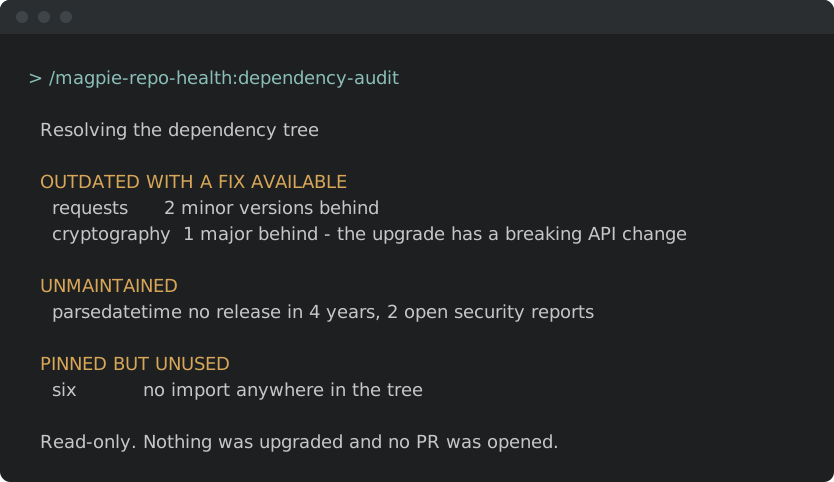
Audit the Actions workflows.
/magpie-repo-health:workflow-security-audit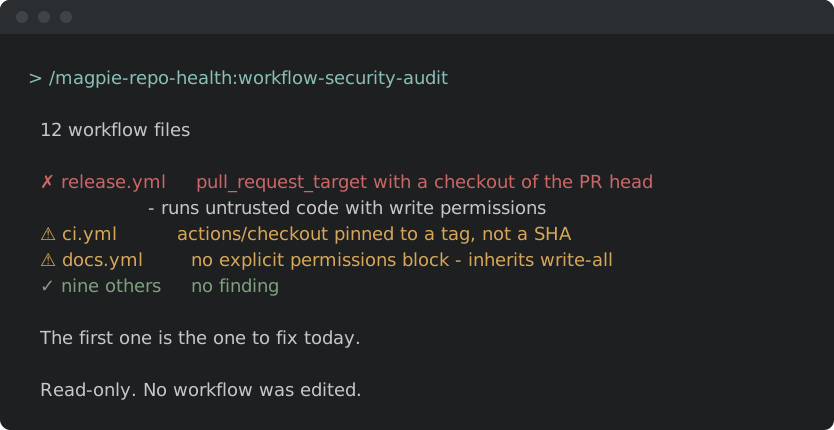
Find the flaky tests.
/magpie-repo-health:flaky-test-triage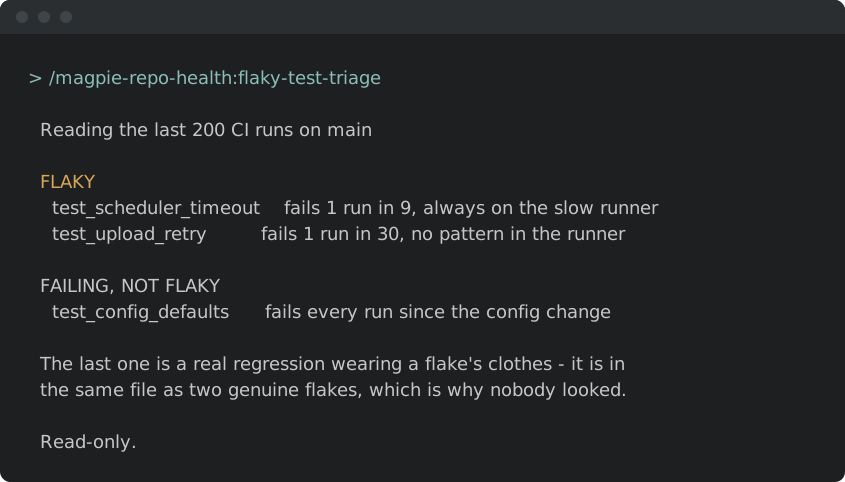
Current skills
audit-finding-fix (experimental)
Takes a single audit finding (from ci-runner-audit,
workflow-security-audit, dependency-audit, or
license-compliance-audit) and drafts a targeted fix PR: code change,
commit message, and PR description. The fix addresses exactly one finding
and includes a regression check where applicable.
Drafts only; the human committer reviews and pushes. Never modifies files or opens PRs without explicit maintainer confirmation.
Adopter contract: reads <project-config>/repo-health-config.md
(audit_finding_fix.pr_template) for the PR description template and
branch-naming convention.
ci-runner-audit (experimental)
Reads every GitHub Actions workflow file across one repo, a named set, one Apache project’s repos, or the full Apache GitHub org and surfaces two classes of issue:
- Obsolete runner labels —
ubuntu-18.04,ubuntu-20.04,windows-2019, and other GitHub-deprecated hosted-runner label strings that silently fall back to a later image or will soon break. - macOS architecture mismatches — a workflow step targeting an
arm64macOS runner that invokes anx86_64-only tool or vice versa.
Output is a markdown audit report grouped by repo and by issue class. Read-only; no workflow files are modified.
workflow-security-audit (experimental)
Runs zizmor — the GitHub Actions
security scanner already wired into the framework’s own pre-commit suite —
across one repository, an explicit repository set, or a whole GitHub org and
surfaces findings for human review.
Finding classes surfaced:
- Injection vulnerabilities —
run:steps consuming${{ github.event.* }}or${{ github.head_ref }}in untrusted contexts. - Excessive permissions —
permissions: write-allor unnecessarywritescopes at the workflow or job level. - Unpinned external actions — floating
@main,@master, or tag-only references instead of a commit SHA. - Self-hosted runner fork-secret leaks — secrets reachable from PRs submitted by fork contributors via self-hosted runners.
Output is a grouped, prioritised finding report. Read-only; the skill never edits workflow files, opens PRs, or posts comments.
Adopter contract: reads <project-config>/repo-health-config.md
(workflow_security_audit.enabled_rules) to select which rule classes to
enable. All classes are enabled by default.
dependency-audit (experimental)
Detects the project’s dependency manager(s), runs the appropriate audit
tool (pip-audit, npm audit, cargo audit, or trivy), and surfaces
patchable vulnerability findings grouped by severity for maintainer triage.
- Works against one repository (
--repo owner/name) or a local checkout (--path /path/to/checkout). - Differentiates CVE-rated vulnerabilities (those with a CVE ID) from advisory-only findings.
- Proposes one upgrade per affected dependency; never modifies manifests, lock files, or opens update PRs autonomously.
Adopter contract: reads <project-config>/repo-health-config.md
(dependency_audit.managers) to select the dependency manager adapter(s).
license-compliance-audit (experimental)
Verify that:
- Every source file under a configured path carries the project’s required SPDX-License-Identifier header line.
- The
LICENSEfile matches the declared SPDX expression. - The
NOTICEfile lists every bundled dependency that its license requires to appear in attribution notices.
Surfaces discrepancies as a structured report (file path, issue class, suggested correction) without modifying any file.
Adopter contract: reads <project-config>/repo-health-config.md for
the required SPDX expression and which source paths to audit.
flaky-test-triage (experimental)
Parse GitHub Actions run history for a named repo over a configurable window, compute per-job failure rates (differentiating consistent failures from intermittent ones), and produce a prioritised triage list: jobs failing above a configurable threshold that are likely flaky rather than deterministically broken.
Signals used: run outcome (success / failure), re-run count on the same
SHA, job-name patterns across runs. No test code is modified.
Adopter contract: reads <project-config>/repo-health-config.md for
the audit window, the failure-rate threshold, and which test-name patterns
to include or exclude.
dependency-license-audit (experimental)
Resolve the license of every direct and transitive dependency and classify
each against the project’s license policy. This is distinct from the two
existing skills: license-compliance-audit checks the project’s own
LICENSE, NOTICE, and SPDX headers (and excludes vendored code), and
dependency-audit checks dependencies for known vulnerabilities, not
license terms. Neither audits the licenses of the dependency tree.
Checks performed:
- Detect the dependency manager(s) (reusing
dependency-audit’s detection) and enumerate direct and transitive dependencies. - Resolve each dependency’s declared license from ecosystem metadata
(
pip-licenses/ PyPI,license-checkerfor npm,cargo-denyorcargo licensefor Rust, ortrivylicense scanning for multi-language). - Classify each result against a configured policy. The default ASF policy applies the three-category model: category A allowed, category B allowed in binary/convenience-binary form only (not in source releases), category X (copyleft such as GPL / AGPL / LGPL, and non-commercial terms) forbidden. Dependencies whose license cannot be resolved are reported as unknown.
Surfaces incompatible, forbidden, and unknown-license dependencies as a grouped report with a proposed remedy per finding (replace, remove, or request a relicense). Read-only; never edits a manifest or lock file.
Adopter contract: reads <project-config>/repo-health-config.md
(dependency_license_audit) for the policy model, explicit allow / forbid
lists, whether to include transitive dependencies, and how to treat
unknown-license dependencies.
Note — optional dependencies are out of scope, and that is usually fine.
The scan reports the resolved/installed dependency graph, so optional extras
and feature-gated dependencies (Python extras, npm optionalDependencies /
peerDependencies, Cargo features, Gradle compileOnly and feature variants,
Maven provided-scope deps) are not covered unless enabled at scan time. For
ASF adopters this is by design rather than a gap: a Category X dependency is
prohibited only when it is distributed in ASF source or a convenience
binary. An optional, non-distributed Category X dependency that merely
supports an optional feature (or a build-time-only tool) is explicitly
permitted, so the default scan already covers what the policy cares about. If
a maintainer wants the full dependency inventory regardless of distribution,
enable all extras and features (for example uv sync --all-extras --all-groups, cargo license --all-features) or audit a full-universe lock
file. See the “may not be distributed” guidance in the ASF resolved-licenses
policy: https://www.apache.org/legal/resolved.html.
Status
Experimental. All seven skills shipped. No adopter-pilot evaluation has run end-to-end yet; shape may change between framework versions.
To provide pilot feedback, copy
docs/pilot-report-template.md into your
project notes, fill in each section, and optionally validate the filled-in
report with:
uv run --project tools/pilot-report-validator pilot-report-validate <your-report.md>Adopter contract
The shape of repo-health-config.md, which the table under
Before the first run links:
repo_health:
  ci_runner_audit:
    # Runner label families to flag. Defaults to the GitHub-deprecated list.
    deprecated_runner_labels: [ubuntu-18.04, ubuntu-20.04, windows-2019]
    # Repos to audit; leave empty to audit only the project's own repos.
    extra_repos: []

  workflow_security_audit:
    # zizmor rule classes to enable (all enabled by default).
    enabled_rules: [injection, excessive-permissions, unpinned-actions, fork-secrets]

  dependency_audit:
    # Dependency manager(s) in use. Selects the audit tool adapter.
    # Allowed values: pip, npm, cargo, maven, gradle
    managers: [pip]

  license_compliance_audit:
    # Required SPDX expression for all source files.
    required_spdx_expression: "Apache-2.0"
    # Source paths to audit (relative to upstream repo root).
    source_paths: [src/, lib/]
    # Paths to skip (test fixtures, vendored code, etc.).
    skip_paths: [tests/fixtures/, vendor/]

  flaky_test_triage:
    # Audit window in days.
    window_days: 30
    # Minimum failure rate (fraction) to flag a test as candidate flaky.
    failure_rate_threshold: 0.1

  dependency_license_audit:
    # License policy model: "asf" applies the ASF category A/B/X model;
    # "allowlist" uses allowed_licenses only.
    policy: asf
    # SPDX expressions always allowed, regardless of policy.
    allowed_licenses: [Apache-2.0, MIT, BSD-2-Clause, BSD-3-Clause, ISC]
    # SPDX expressions always forbidden (category X).
    forbidden_licenses: [GPL-2.0-only, GPL-3.0-only, AGPL-3.0-only, LGPL-3.0-only]
    # Include transitive dependencies (default true).
    include_transitive: true
    # What to do when a dependency's license cannot be resolved: flag | ignore.
    unknown_license_action: flag
Cross-references
docs/modes.md§ Triage — mode taxonomy; repo-health skills are listed in the Triage table.tools/spec-loop/specs/repo-health-family.md— functional spec: acceptance criteria, validation commands, and known gaps.tools/spec-loop/specs/triage-mode.md— parent spec that identified the family gap.