
Agentic Pairing skill family
Scope. Works on any project, ASF or not — no Apache-Software-Foundation-specific assumptions baked in.
Developer-side pre-flight review skills that run in the maintainer’s or contributor’s own dev loop — after local changes are ready but before opening a PR. The family absorbs mechanical implementation-detail review so the eventual human-to-human conversation between contributor and maintainer stays on design, reasoning, and the trade-offs the project cares about.
Mentorship is intrinsic. Agentic Pairing skills are not a replacement for human code review; they are a pre-flight filter that separates implementation-detail nits (formatting, convention violations, obvious logical gaps) from the design-level conversation the project’s contributor-to-committer path is built on.
No state changes. Every skill in this family reads local git state and returns a structured report. No PR is opened, no GitHub write happens, no comment is posted, and the working tree is never mutated.
Install & first runs
Install just this family — one plugin, 2 skills. Review your own change before anyone else has to.
Once you have added the marketplace:
/plugin install magpie-pairing@apache-magpieNew to Magpie? The quick start walks the whole path in
one place — install, the first /magpie-setup run, and a recording of it
happening — plus the other agents and the secure-isolation setup to run next.
Before the first run
Nothing here has to be configured. These skills read the file below
when it exists — yours in .apache-magpie-local/ or the project’s in
.apache-magpie-overrides/ — and fall back to a documented default when
it does not.
Optional. Each has a documented fallback; absent, the skill still runs.
| File | What it carries | Read by |
|---|---|---|
project.md |
Project manifest. Identity, repositories, mailing lists, tools enabled, CVE tooling, GitHub project-board + issue-template field declarations. The single file every skill reads to resolve project-scoped references. | multi-agent-review, self-review |
Works well with
Third-party packages, none of them required: this family works with none of them installed, and Magpie neither bundles nor depends on any. They are named because they are what a maintainer goes looking for next, and because the answer differs by agent.
Code Review — Anthropic
Automated pull-request review through several specialised agents, scored by confidence.
With this family: Runs the same kind of pass over a PR that self-review runs over your local diff.
Available on Claude Code only.
Superpowers — obra (community)
A skills library and development methodology: brainstorming, plan writing, subagent-driven execution, systematic debugging.
With this family: self-review and multi-agent-review are pre-flight reads of your own diff; Superpowers adds the test-first and systematic-debugging habits upstream of them.
Available on Claude Code, OpenAI Codex CLI, VS Code / GitHub Copilot, Google Gemini CLI, Cursor, OpenCode.
Installing it means first adding a marketplace Magpie does not publish — obra/superpowers-marketplace. The install flow asks before it does, and names whose it is.
Ships a plugin manifest per harness and one shared skills/ tree, the same shape Magpie uses, so it is not a Claude Code-only package.
Install commands per agent are in Companion skill packages.
Try these first
Illustrative shapes, not real transcripts — your output will differ. Both skills are read-only: nothing is sent, merged, or posted.
Self-review before you push.
/magpie-pairing:self-review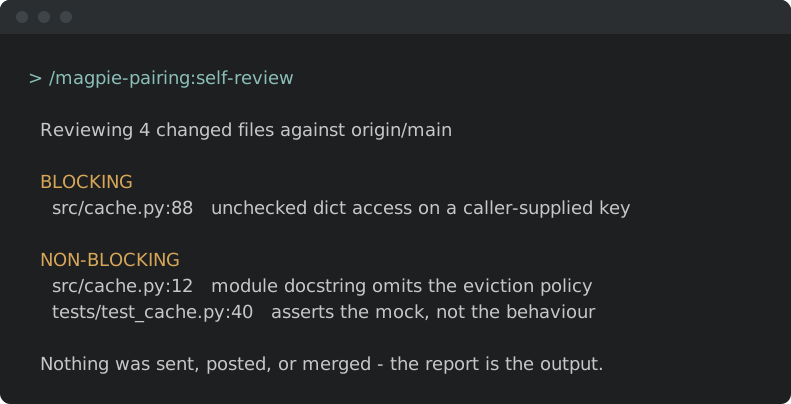
Send it through an adversarial panel.
/magpie-pairing:multi-agent-review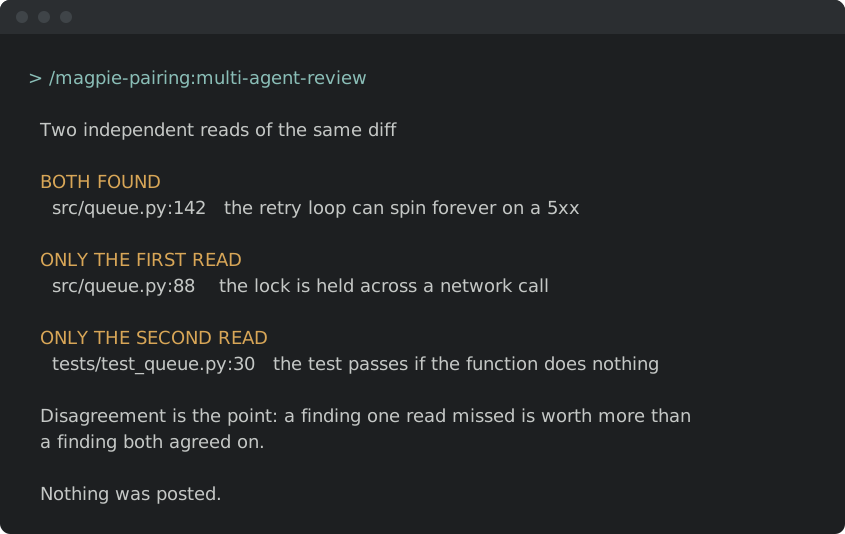
Skills
| Skill | Purpose | Status |
|---|---|---|
pairing-self-review |
Structured pre-flight self-review of local changes against a configurable base. Single-pass: correctness, security, and conventions in one report. | experimental |
pairing-multi-agent-review |
Fan the same diff through three independent axis-focused passes (correctness, security, conventions); merge findings with deduplication and severity ranking. Higher confidence than a single pass; each axis is isolated so findings cannot cross-contaminate. | experimental |
When to use which
pairing-self-review— the default quick check. Fast, single context, covers correctness + security + conventions.pairing-multi-agent-review— when you want adversarial independence between review axes. Each pass cannot see the others’ findings, so a security issue buried in a conventions sweep cannot get lost. Use for changes touching security-sensitive paths or for the final check before a high-stakes PR.
Both skills are read-only / hand-back and produce the same structured report format, so you can switch between them without changing your workflow.
Relationship to pr-management-code-review
pairing-self-review and pairing-multi-agent-review run before a
PR is open. Once a PR is open and you want a maintainer-side deep code
review of an incoming contribution, use
pr-management-code-review
instead.
Adopter contract
The Agentic Pairing skills read local git state and write nothing: no PR is
opened, no comment posted, and the working tree is never mutated. They resolve
<upstream> and <project-config> placeholders when the project defines
them, and run without either.
Status
Experimental. Both pairing-self-review and
pairing-multi-agent-review are shipped and validate under
skill-and-tool-validate. No adopter-pilot evaluation has run yet;
shape may change between framework versions.
To provide pilot feedback, copy
docs/pilot-report-template.md into your
project notes, fill in each section, and optionally validate the filled-in
report with:
uv run --project tools/pilot-report-validator pilot-report-validate <your-report.md>Cross-references
MISSION.md§ Agentic Pairing — mode rationale, sequencing constraints relative to Agentic Autonomous.docs/modes.md§ Pairing — implementation status and mode-lifecycle stage.docs/modes.md§ Mode lifecycle — how a mode moves fromexperimentaltostable.projects/_template/README.md— adopter scaffold index.docs/setup/agentic-overrides.md— the override mechanism every skill in this family supports.