
Contributor-growth skill family
Scope —
organization: ASF· 🪶 ASF-specific. This family encodes Apache Software Foundation processes (the contributor-to-committer path) and assumes an ASF adopter profile by default. Non-ASF projects can still adopt it through the adapter/config layer, but it carries ASF assumptions the generic families do not.
Maintainer-facing skills that span the contributor-to-committer path: welcoming first-time contributors, keeping the issue backlog newcomer- ready, tracking contribution activity, checking readiness against declared thresholds, measuring contributor sentiment, assembling nomination evidence, and walking nominators through post-vote onboarding. Nine skills cover the staged path from first contact through committer promotion.
Why a framework skill family? The contributor-to-committer path is one of the highest-leverage levers an open-source project has for long-term health — lowering onboarding friction and shortening the time from first PR to committer status keeps the contributor pipeline healthy. These skills were designed independently but cover a contiguous path; grouping them makes the adopter configuration and the evaluation story coherent.
Install & first runs
Install just this family — one plugin, 9 skills. The path-to-committer track.
Once you have added the marketplace:
/plugin install magpie-contributor-growth@apache-magpieNew to Magpie? The quick start walks the whole path in
one place — install, the first /magpie-setup run, and a recording of it
happening — plus the other agents and the secure-isolation setup to run next.
Before the first run
Illustrative — the real run derives more and asks better. What is true is the shape: it runs itself, it writes only gitignored files, and it stages nothing.
Every skill here resolves project-specific values from the adopter’s
<project-config>/ directory — which is
.apache-magpie-local/ (gitignored, yours) first, then
.apache-magpie-overrides/ (committed, the project’s).
For yourself: /magpie-setup config scaffolds and fills these locally.
Nothing is staged, nothing is committed, and it works on a repository that
has never adopted Magpie.
For the project: /magpie-setup adopt
commits them for every contributor, either scaffolded directly or promoted
from what you configured locally.
Required. Without these a skill would act on a guess, so it stops and says which file is missing.
| File | What it carries | Read by |
|---|---|---|
committer-onboarding-config.md |
Capability-flag vocabulary for committer intake and governance models (icla/dco/no-cla; asf-pmc/github-codeowners/maintainer-roster). |
committer-onboarding |
committer-readiness.md |
The project’s declared committer and PMC thresholds — what a contributor’s activity is measured against. | calibrate, candidate-screen, contributor-to-committer |
contributor-nomination-config.md |
Nomination-brief thresholds and assessment window. | calibrate, candidate-screen, nomination |
contributor-sentiment-config.md |
Signal thresholds for the sentiment gate. Every key has a default. | sentiment |
onboarding-concierge-config.md |
The path a new contributor is walked through, and who owns each step. | onboarding-concierge |
privacy-llm.md |
Which model tier may see which class of content, for projects routing foundation-private information away from third-party models. | calibrate |
project.md |
Project manifest. Identity, repositories, mailing lists, tools enabled, CVE tooling, GitHub project-board + issue-template field declarations. The single file every skill reads to resolve project-scoped references. | activity-sweep, calibrate, candidate-screen, committer-onboarding, contributor-to-committer, identity-map, nomination, onboarding-concierge, sentiment |
Optional. Each has a documented fallback; absent, the skill still runs.
| File | What it carries | Read by |
|---|---|---|
contributor-identities.md |
The project’s community channels, and confirmed mappings from each contributor’s GitHub handle to their Slack, Discord, mailing-list, and social-media handles. Written by contributor-identity-map after a maintainer confirms each one. |
committer-onboarding, identity-map |
pmc-roster.md |
Who is binding. Read wherever a vote is counted or a PMC-only action is gated. | candidate-screen, nomination |
Try these first
Illustrative shapes, not real transcripts — your output will differ. Nothing below sends, merges, or posts anything without you confirming it.
Sweep recent contributor activity.
/magpie-contributor-growth:activity-sweep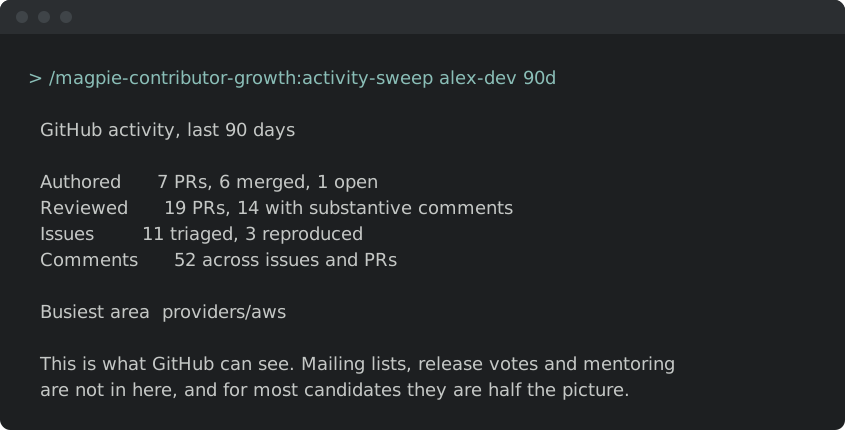
Draft a nomination brief.
/magpie-contributor-growth:nomination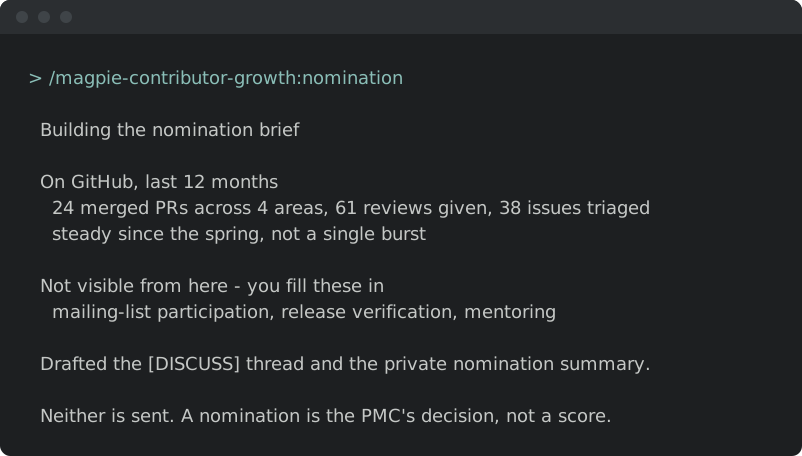
Onboard a new committer.
/magpie-contributor-growth:committer-onboarding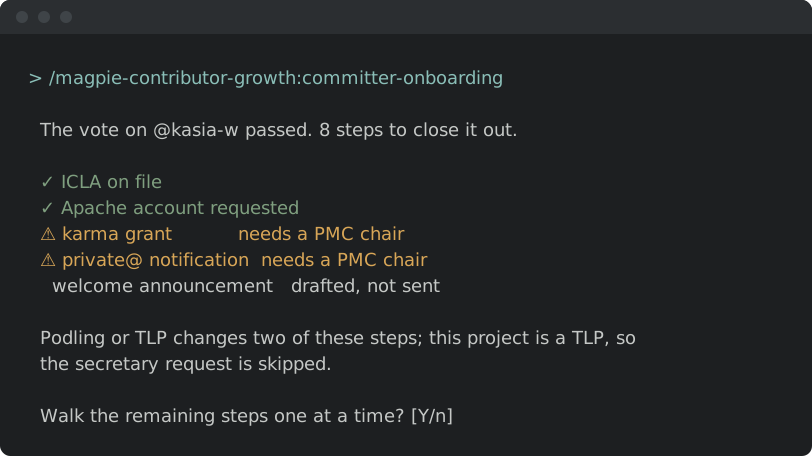
Stage coverage
| Stage | Skill | What it does |
|---|---|---|
| First contact | mentoring-welcome |
Drafts an orientation comment for a first-time contributor on a newly opened issue or PR; detects first-time authorship via the GitHub author_association field and skips repeat contributors. |
| Issue on-ramp | good-first-issue-author |
Drafts one net-new good first issue from a supplied gap or small task; a suitability gate and R1–R9 readiness checklist gate the draft; waits for maintainer confirmation before filing via gh. |
| Backlog curation | good-first-issue-sweep |
Sweeps the open issue backlog for existing issues that could be labelled as good first issues; scores each against the G1–G7 suitability rubric; classifies as READY / NEAR-MISS / SKIP and proposes labels after explicit maintainer confirmation. |
| Activity tracking | contributor-activity-sweep |
Produces a read-only GitHub activity card (PRs authored, code reviews, issues, comments) over a configurable window. |
| Calibration | contributor-calibrate |
Derives committer and PMC threshold floors from the project’s own past nomination decisions on the private list; proposes a config diff holding numbers only, with nothing about any nominee leaving the session. |
| Candidate screening | contributor-candidate-screen |
Screens every recent contributor against the calibrated floors, shortlists committer and PMC candidates, and writes a per-candidate evidence report — areas, floors, community signals, two or three paragraphs each — to a repository the GitHub API reports as private, after the maintainer has read it. |
| Readiness check | contributor-to-committer |
Maps a contributor’s GitHub activity against the adopter’s PMC-declared committer or PMC thresholds; surfaces a traffic-light brief (Not yet / Approaching / Ready to nominate) and a gap table showing what would close each remaining gap. Read-only; never opens a nomination thread. |
| Identity mapping | contributor-identity-map |
Maps any contributor’s GitHub handle to their Slack, Discord, Matrix, mailing-list, and social-media handles; infers from the sources the session can reach and records only the mappings a maintainer confirms. Used by committer-onboarding and contributor-nomination. |
| Nomination brief | contributor-nomination |
Assembles evidence prose for a committer or PMC vote thread: activity breadth, consistency, vendor-neutrality context, and a nomination-ready summary. Read-only; never posts to any list. |
| Sentiment analysis | contributor-sentiment |
Analyse contributor sentiment signals (issue tone, PR abandonment, response-time frustration) to surface early-warning indicators of contributor disengagement. Read-only. |
| Onboarding concierge | onboarding-concierge |
Interactive first-session guide for new contributors: walks through repo setup, points to good first issues, introduces project conventions and communication channels. |
| Post-vote onboarding | committer-onboarding |
Walks the nominator through ICLA check, account provisioning, permissions grant, and the welcome announcement for committer and PMC promotions at ASF TLPs and podlings. |
Every stage is read-only on governance artefacts or propose-before-post: no skill modifies a roster, posts an announcement, or files an issue without explicit maintainer confirmation.
Skills
| Skill | Mode | Status |
|---|---|---|
mentoring-welcome |
Mentoring | experimental |
good-first-issue-author |
Mentoring | experimental |
good-first-issue-sweep |
Mentoring | experimental |
contributor-sentiment |
Triage | experimental |
onboarding-concierge |
Mentoring | experimental |
contributor-activity-sweep |
Triage | experimental |
contributor-identity-map |
Triage | experimental |
contributor-to-committer |
Mentoring | experimental |
contributor-nomination |
Triage | experimental |
contributor-calibrate |
Triage | experimental |
contributor-candidate-screen |
Triage | experimental |
committer-onboarding |
Triage | experimental |
All twelve skills are experimental; no adopter has run the full
contributor-to-committer path under evaluation conditions yet.
Family boundary
This family sits alongside two overlapping skill families:
docs/mentoring/README.md— the Agentic Mentoring mode spec and family overview.mentoring-welcome,good-first-issue-author, andgood-first-issue-sweepcarrymode: Mentoringand are also listed in that spec. The families cross-reference each other; a later maturity review may clarify the boundary or merge the two into one.docs/issue-management/README.md— general-issue triage and fix workflow. The contributor-growth family reads GitHub activity data about contributors, not issue content; the two families use different query surfaces and produce different artefacts (activity cards and nomination briefs vs. issue disposition proposals).
Skills in this family propose every state-changing action for human
sign-off. committer-onboarding emits paste-ready command recipes the
nominator executes as themselves; no skill submits an ICLA form, invites
an account, or modifies repository permissions without the nominator’s
direct action.
Status
Experimental. All eleven skills are on main with eval suites; no adopter has run the full contributor-to-committer path end-to-end under evaluation conditions.
Known deferred items (each pending a spec-RFC pass that enumerates per-project policy knobs before a skill can safely propose anything):
- PMC-member nomination — vote mechanics, quorum rules, and
post-vote steps differ from committer promotion and warrant a
separate capability-flag variant of
committer-onboardingor a standalone skill. - Emeritus / inactive-committer handling and contributor offboarding — these involve project-level governance decisions (roster policy, access removal, farewell communication norms) that need per-project configuration.
Cross-references
docs/modes.md§ Triage — mode taxonomy the three Agentic Triage-mode family skills declare against.docs/modes.md§ Mentoring — mode taxonomy the three Agentic Mentoring-mode family skills declare against.docs/mentoring/README.md— the Agentic Mentoring mode family overview, which cross-referencesmentoring-welcome,good-first-issue-author, andgood-first-issue-sweep.projects/_template/README.md— adopter scaffold index, with a purpose line for every file the table under Before the first run links.docs/setup/agentic-overrides.md— the override mechanism every skill in this family supports.